YSO Bulletin
- May 2026 -
 The YSO Newsletter
AB Aur yet Again!
The Herbig Ae star AB Aurigae hosts a vast, low-inclination protoplanetary disk that exhibits a plethora of substructures, including the protoplanet candidate AB Aur b. Now M-band spectroscopic data taken with NASA IRTF from Feb 2024, covering multiple position angles has revealed emission from an off-centred, low temperature, and compact source. Analysis of various signals localizes the source at around an orbital radius of 65 AU and a position angle of 143°. These coordinates are distinctly different from those of AB Aur b, which was not detected. Although there is no obvious explanation for the detected source, if it is assumed that it was a circumplanetary disk, then its maximum temperature would be about 550 K and its maximum radius would be about 5 AU. The results could inicate a previously unknown companion that may be residing in the AB Aurigae system.
...and T Tauri yet again!
The iconic T Tauri system was recently observed using ALMA to cover periastron passage in 2023 of the T tau Sa / Sb binary. (T Tauri is a hierarchical triple system). The ALMA images were obtained in epochs spanning November 2019 through June 2023, and therefore covered the time frame of the recent periastron passage. The binary was clearly resolved in two epochs of high-resolution measurements with ALMA. There were increases in millimetre flux, from heating of the Sa disk and the wider distribution of dust in the environment of the binary. This heating is likely in response to increased stellar accretion activity triggered by orbital motion during the dynamic periastron passage of T Tau Sb around Sa.
Resolved, extended millimetre emission is also found to change morphology and increase in flux in the immediate environment of the Sa-Sb binary after periastron passage, which may suggest an increase in nonthermal emission from magnetic interaction, gravitational disruption of the circumstellar disks as the stars passed through periastron, or both of these phenomena. Structures were also detected in the compact (24 au radius), thermal dust disk around T Tau N. Furthermore, a crescent-shaped emission excess was found just outside a shallow gap at 12 AU radius that appears to move at Keplerian speed - so as with AB Aur, these systems with long baselines of observations continue to demonstrate their dynamism!
Making Multiples
Understanding the formation pathway for close-companion protostars is central to unraveling the processes that govern stellar multiplicity and very early star formation. A recent study took a large sample of 51 Class 0/I (i.e, very young) close-companion protostellar systems, of which 38 show detectable outflows, yielding 42 measured outflows used in their analysis. ALMA observations of 11 systems in Perseus and 40 systems in Orion were used. These companions formed either directly at small scales (less than about 500 AU separations) via disk fragmentation, or at larger scales (above 1000 AU) via turbulent fragmentation followed by inward migration.
Because of differences in formation mechanism, the former is expected to have preferentially aligned disks and outflows, whereas the latter is expected to show no preferred alignment. The relative prevalence of these formation pathways remains uncertain, yet it is critical to forming a comprehensive picture of star formation. They examined the distribution of position angles of companion protostars relative to the position angles of their molecular outflows. The outflow is a useful proxy for the angular momentum of the system, expected to be orthogonal to the binary orbital plane, which was generally found to be the case here and suggesting that disk fragmentation is the dominant formation pathway for close-companion protostellar systems.
A new FUOR?
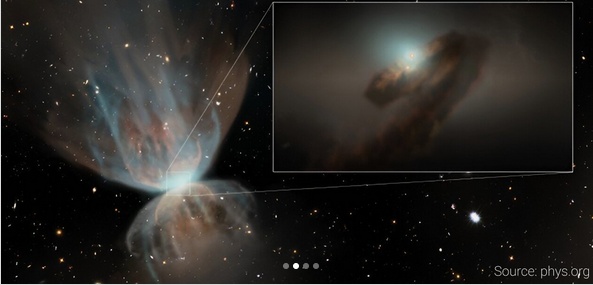 A Russian study using photometric, polarimetric, and spectroscopic observations are presented for the young star IRAS 21204+4913, whose visible brightness has increased by around 5 magnitudes since October 2025. The star's absorption spectrum resembles those of A - F giants and supergiants, but it also exhibits molecular TiO bands. The brightening was accompanied by a significant increase in the degree of polarization of the stellar radiation, likely due to scattering by dust in an expanding circumstellar shell. The P Cygni profile of the Hα line implies a dusty wind velocity of about 300 km/s. It is thought that the outburst is caused by an increase in the accretion rate of protoplanetary disk matter onto the young star with a mass of up to 3 x 10⁻⁵ Solar mass per year. Furthermore, the star displays several unusual features, notably another outburst that occured in 1948. Several T Tauri stars and a group of Herbig-Haro objects are also found in the vicinity of the star (I will be creating a sequence for this object if suitable).
Stop Press: sequence has been created and is available through VSP.