YSO Bulletin
- September 2025 -
 YSO Newsletter
Observational Section: one to watch - a challenge
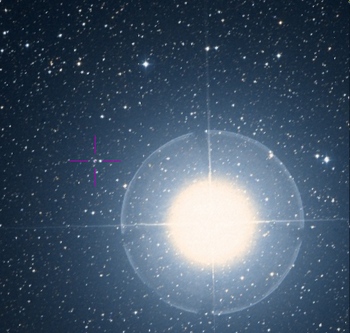 BE Cas is an F-type (so probably UXOR type) YSO discovered in a survey of the field around β Cas by that great observer Hoffmeister. I have been observing it for a while and it has usually been around magnitude 12.3 but recently it has shown something of a fade. The challenge arises because of its close proximity to the 2nd-magnitude star, and also from the fact that it has a quite close companion (actually a comp star) of magnitude 13.3.
The field around β Cas contains several YSOs such as MQ Cas and V633 Cas, this last mentioned in an excellent paper (=LkHa 198) by none other than Herbig himself.
The Inflow and the Outflow
Star formation is an intrinsically complex process involving the collapse and accretion of matter onto proto-stellar objects and infall and outflow motions play and important role in the star formation processes. However, comprehensive understanding of both processes, particularly towards massive star-forming regions, is still lacking. In part, this is because of the larger distances involved and the typically more clustered and complex nature of star formation regions, making it difficult to disentangle the infall and outflow properties of individual objects in a given cluster.
A Chinese study describes how a total of 188 high-mass outflows have been identified from a sample of 694 clumps from the Millimetre Astronomy Legacy Team 90 GHz survey, representing a detection rate of approximately 27%. The detection rate of outflows increases from the protostellar stage to the H II stage, but decreases again at the photodissociation (PD) stage, suggesting that outflows are being switched off during this stage. An intimate relationship is found between outflow action and the presence of masers, and water masers appear together with 6.7 GHz methanol masers. Comparing the infall detection rate of clumps with and without outflows, they find that outflow candidates have a lower infall detection rate. Finally, it seems that outflow action has some influence on the local environment and the clump itself, and this influence decreases with increasing evolutionary time as the outflow action ceases.
You can never have enough rings
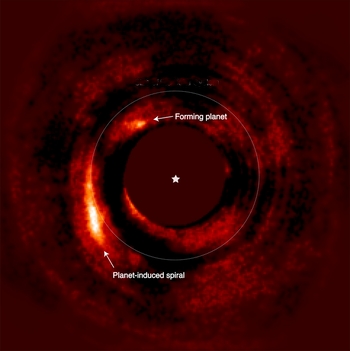 A major international team produced a detailed multi-wavelength characterization of the multi-ring disk of HD 169142, an 8th-magnitude star close to δ Sgr. They report new ALMA observations at 3 mm and analyzed them, together with archival 0.89 and 1.3 mm data. The observations resolved three out of the four rings in the disk previously seen in high-resolution ALMA data. A simple parametric model was used to estimate the radial profile of the dust's optical depth, temperature, density, and particle size distribution. They found that the multiple ring features of the disk are produced by annular accumulations of large particles, probably associated with gas pressure bumps. Their model indicates that the maximum dust grain size in the rings is around 1 cm, though with a slightly flatter power-law size distributions than the ISM-like size distribution found in the gaps. In particular, the inner ring at about 26 AU is associated with a strong and narrow buildup of dust particles that could harbour the necessary conditions to trigger the streaming instability. According to their analysis, the snowlines of the most important volatiles do not coincide with the observed substructures. They went on to explore different ring formation mechanisms and find that planet-disk interactions are the most likely scenario to explain the main features of HD 169142. Overall, the multi-wavelength analysis provides some of the first unambiguous evidence of the presence of radial dust traps in the star's rings. A similar analysis in a larger sample of disks could provide key insights on the impact that disk substructures have on the dust evolution and planet formation processes.
Note: the picture links to a page with Javascript. Just say 'no' if asked if you want to run scripts.