YSO Bulletin
- October 2025 -
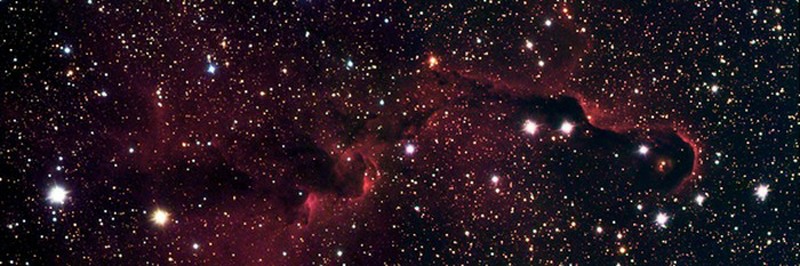 The YSO Newsletter
Massive Catalogue
The third installment of the Massive Star-forming Regions Omnibus X-ray Catalog (MOXC3), a compilation of X-ray point sources detected in 50 archival Chandra/ACIS observations of 14 Galactic Massive Starforming Regions and surrounding fields. The objects listed have distances of 0.7 kpc to 4.2 kpc and most exhibit clumped or clustered young stellar populations. From the information in the catalogue they can also be seen to adhere closely to the galactic equator (with one outlier NGC 281 at about 6° South of it); several contain at least two distinct massive young stellar clusters. The total MOXC3 catalog includes 27,923 X-ray point sources (young stars - especially massive young stars - are X-ray sources as a result of the violent processes associated with starbirth). The study revealed diffuse X-ray structures that pervade and surround MSFRs, often generated by hot plasmas from massive star feedback. As was found in the preceding two versions of the catalogue, diffuse X-ray emission is traceable in the 3rd version as well. One notable region investigated is the area around the 5th-magnitude runaway star AE Aurigae.
More Massiveness!
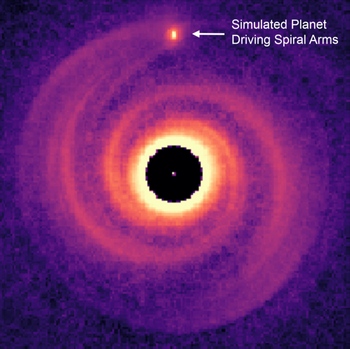 Theoretical studies suggest that a giant planet around the young star MWC 758 could be responsible for driving the
spiral features in its circumstellar disk. A deep imaging campaign with the Large Binocular Telescope had the primary goal of imaging the predicted planet. They extracted images of the disc in two epochs in the L′ filter (3.8 μm) and a third epoch in the M′ filter (4.8 μm). The two prominent spiral arms are detected in each observation, which constitute the first images of the disk at M′, and the deepest yet in L′. The study also reported the detection of a source near the end of the Southern arm, and, from the source’s detection at a consistent position and brightness during multiple epochs, it is very likely that the source is of an astrophysical origin. This feature may be an unresolved disk feature, or a giant planet responsible for the spiral arms, with several arguments pointing in favor of the latter scenario. It emerged that there is a suggestion that a planet of nearly 4 Jupiter masses exterior to the spiral arms could have escaped detection. The object is located in Taurus in the same area as the well-known YSOs RR and CQ Tau.
Theoretical studies suggest that a giant planet around the young star MWC 758 could be responsible for driving the
spiral features in its circumstellar disk. A deep imaging campaign with the Large Binocular Telescope had the primary goal of imaging the predicted planet. They extracted images of the disc in two epochs in the L′ filter (3.8 μm) and a third epoch in the M′ filter (4.8 μm). The two prominent spiral arms are detected in each observation, which constitute the first images of the disk at M′, and the deepest yet in L′. The study also reported the detection of a source near the end of the Southern arm, and, from the source’s detection at a consistent position and brightness during multiple epochs, it is very likely that the source is of an astrophysical origin. This feature may be an unresolved disk feature, or a giant planet responsible for the spiral arms, with several arguments pointing in favor of the latter scenario. It emerged that there is a suggestion that a planet of nearly 4 Jupiter masses exterior to the spiral arms could have escaped detection. The object is located in Taurus in the same area as the well-known YSOs RR and CQ Tau.
Complex Cloud Activity
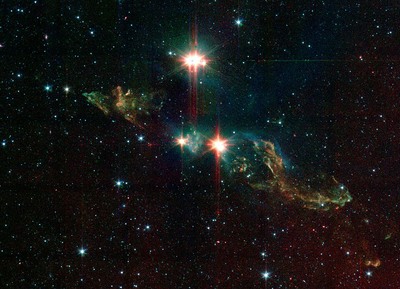 We stay in Taurus for L1551 IRS 5, which is a FUor-like binary. Multibaseline observations with ALMA recovered the two circumstellar disks involved with the system and for the first time resolved the circumbinary ring. It is located at the edge of a dense molecular cloud L1551 and has an atomic jet and an aligned molecular outflow that displays well separated blue- and red-shifted outflow lobes. Both stars are surrounded by a dust and gas disk that could be forming planetesimals. The larger star will be like the sun when it gets older, while the secondary is much smaller and will eventually be a red dwarf. At the moment they are entering the very active T Tauri phase with jets and gas outflows, including HH 154, as can be seen here. IRS5 is the bright star at centre.