YSO Bulletin
- November 2025 -
 The YSO Newsletter
It's hot out there!
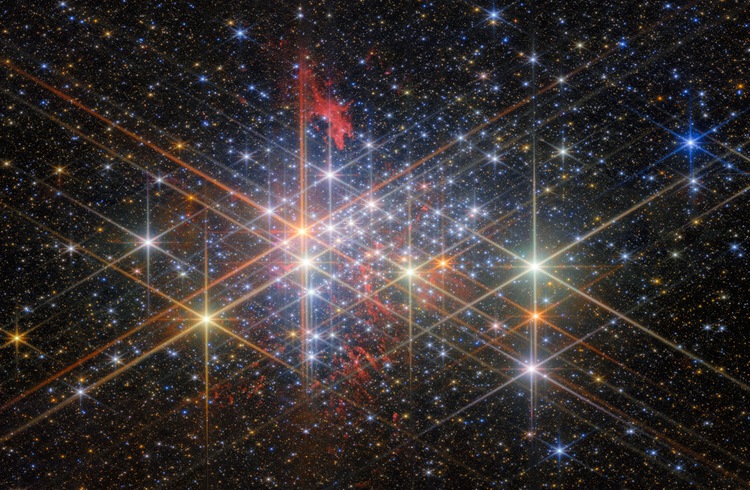
The formation, properties, and evolution of massive stars remain subject to considerable uncertainty; impacting on fields such as galactic feedback. The clusters many such stars reside within provide a unique laboratory for addressing these issues, and in a British/Spanish census of the young, massive cluster Westerlund 1, 69 new members were
identified via I-band spectroscopy, yielding a total cluster population of 166 stars with initial masses of ∼25 - 50M☉, with more massive stars already lost as supernovae. The stellar population follows a smooth and continuous
morphological sequence from late-O giant through to OB supergiant.
 Subsequently, the progression bifurcates, with one branch yielding mid- to late-B hypergiants and cool super-/hypergiants, and the other massive blue stragglers, prior to a diverse population of H-depleted Wolf-Rayet stars. A substantial population of O-type stars with anomalously broad Paschen series lines are seen, a property which suggests binarity. Binary interaction is clearly required to yield the uniquely rich cohort of hypergiants, which includes both mass-stripped primaries and rejuvenated secondaries/stellar mergers. As a consequence, future observations of Wd1 and similar stellar aggregates hold out the prospect of characterising both single- and binary- evolutionary channels for massive stars and determining their relative contributions. This in turn will permit the physical properties of such objects at the point of core-collapse to be predicted.
Wd 1 is the most massive young cluster in the milky way and lies in the constellation of Ara. It contains between 50,000 and 100,000 times the mass of the Sun, yet all of its stars are located within a region less than six light-years across!
Go Jets!
It is important to determine if massive stars form via disc accretion, like their low-mass counterparts. Theory and observation indicate that protostellar jets are a natural consequence of accretion discs and are likely to be crucial for removing angular momentum during the collapse. However, massive protostars are typically rarer, more distant
and more dust-enshrouded, making observational studies of their jets more challenging.
A fundamental question is
whether the degree of ionisation in jets is similar across the mass spectrum. It turns out that the ionisation fraction from the massive protostar G35.20-0.74N as revealed by ALMA is similar to the values found in jets from lower-mass young stars, implying a unified mechanism of shock ionisation applies in jets across most of the protostellar mass spectrum, up to at least about10 solar masses.
Star Formation in 3-D
It's easy to think that the various starforming regions are simply spread out over the sky because our human eyes do not really see the night sky in 3 dimensions - but of course reality is different! Results using Gaia, looking at the giant Taurus starforming region show that the molecular clouds are located at different distances and confirm the existence of important depth effects in the region reported in previous studies. For example, the L 1495 molecular cloud is located at around 130 pc distance, while the filamentary structure connected to it (in the plane of the sky) is at 160 pc. The closest component of the region is the dark nebula B 215 at 128 pc while the most remote is the filamentary structure L 1558 at 198 pc.
The median inter-cloud distance is 25 pc and the relative motion of the subgroups is in the order of a few km/s. There is no clear evidence for radial size change of the Taurus complex, but there are signs of the potential effects of a global rotation. Radial velocity measurements confirm that the stars and the gas are tightly coupled.