YSO Bulletin
- May 2025 -
HD 97048
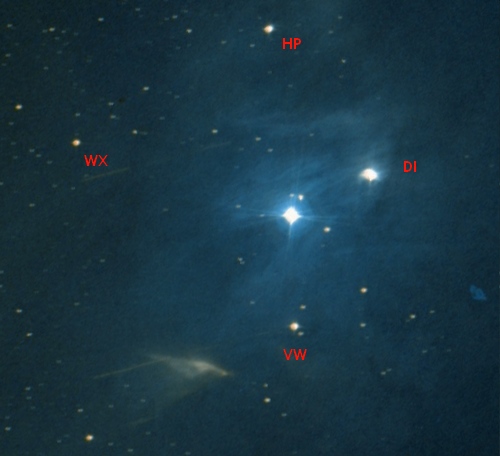 This is an eighth-magnitude object in the extensive Chamaeleon starforming region, also known by its variable star name of CU Cha. It is a high-mass HAeBe star that is now known to possess a planet with a mass of about 2 Jupiters, and the stellar environment is very strong in Polycyclic Aromatic Hydrocarbons (PAH) which are present in the ISM. It is believed the inner edge of the disc is slightly flared as a result of its proximity to the B/A-spectrum star and, as a consequence, shadows the outer areas of the disc. CU (near centre) and DI nearby illuminate an extensive reflection nebula often found near HAeBe objects (picture is about 15' on a side, blue enhanced to show the nebulosity better). CU Cha is a member of the Cha T1 association and is one of the more massive of its members. Virtually every star in the picture here is a YSO, and I have labelled some of the better-known. Disks around Herbig Ae stars are the progenitors of gas-giant planetary systems around A-type stars, which have the highest occurrence rate of gas-giant planets across the stellar mass range.
Meanwhile, not far away...
HD 100546 is another star of the same type, just over the border in the southern constellation of Musca. This time a much closer-in planet is suspected. The star is surrounded by a disc with a large central region that is cleared
of gas and dust (i.e., an inner hole). High-resolution NIR spectroscopy reveals a rich spectrum of CO emission lines whose time-variable properties point to the presence of an orbiting companion within the hole. The Doppler shifts of one of these CO lines, observed from 2003 to 2013, are consistent with a source of excess CO emission that orbits the star near the inner rim of the disc. The properties of the excess emission suggest a circumplanetary disc. We have seen this in other baby planets such as in the case of V1400 Cen, discussed in past newsletters.
Such High-res spectroscopy of the circumplanetary material surrounding forming gas giant planets will help to elucidate the physics of planet formation. For example, determining how material accretes from the circumstellar to the circumplanetary disc and finally onto the planet itself will shed light on what sets the mass of gas giant planets. Measuring the size and temperature of circumplanetary discs will provide observational constraints on the initial conditions for the in situ formation of satellites such as the Galilean moons.
Info Point: cloud collapse
Star formation is thought to be driven by two groups of mechanisms; spontaneous collapse and triggered collapse.
Triggered star formation mechanisms further diverge into cloud-cloud collision (CCC), "collect and collapse" (C&C)
and shock-induced collapse of pre-existing, gravitationally stable cores, or radiation driven implosion (RDI). To
evaluate the contributions of these mechanisms and establish whether these processes can occur together within the
same starforming region, one can map both radio frequency ammonia and water maser emission lines. Taking the huge starforming complex Sharpless 235 in Auriga as an example, high density gas in inter-core bridges which physically link dense molecular cores housing young proto-stellar clusters is found.
The presence of these dense gas clumps implies the potential for future star formation within the system of cores and gas bridges. Cluster formation implies collapse and these continuous physical links suggest a common origin to the molecular cores housing these clusters (i.e., the structure has condensed from a single, larger parent cloud, brought about by the influence of a local expanding HII region.
S235 is the brightest, though not the largest, of an extensive complex of HII clouds in the area, and has several smaller 'satellite' Sharpless gas clouds, S235A, B and C. There is a good view of the whole region, with annotations, at the excellent image site of Jim Thommes.
