YSO Bulletin
- March 2026 -
 The YSO Newsletter
Major ALMA Survey
The outer regions of exoplanet systems host dusty debris discs analogous to the Kuiper belt, which provide crucial constraints on planet formation and evolution processes. ALMA dust observations have revealed a great diversity among such instances. Progress, however, has been limited by low-resolution observations,so a large programme was begun at ALMA dedicated to debris discs: the ALMA survey to Resolve exoKuiper belt Substructures (ARKS). The 24 most promising belts to constrain their detailed radial and vertical structure were chosen and the first ARKS results are presented as a series of ten papers. ARKS revealed a great diversity of structures in exoKuiper belts that may arise when they are formed in protoplanetary discs or subsequently via interactions with planets and/or gas. It was found that up to 33% of the sample exhibits multiple dusty rings, for instance.
They found that of the 24 discs in the sample, 5 host multiple rings, 7 are single rings that display halos or additional low-amplitude rings, and 12 are single rings with, at most, tentative evidence of additional substructures. The fractional ring widths that were measured are significantly narrower than previously derived values, and they follow a distribution similar to the fractional widths of individual rings resolved in protoplanetary discs. However, there exists a population of rings in debris discs that are significantly wider than those in protoplanetary discs. Also discs with steep inner edges consistent with planet sculpting tend to be found at smaller (<100 AU) radii, while more radially extended discs tend to have shallower edges more consistent with collisional evolution. While the findings suggest that it may be possible for some debris discs to inherit their structures directly from protoplanetary discs, there exists a sizeable population of broad debris discs that cannot be explained in this way.
SVS 13
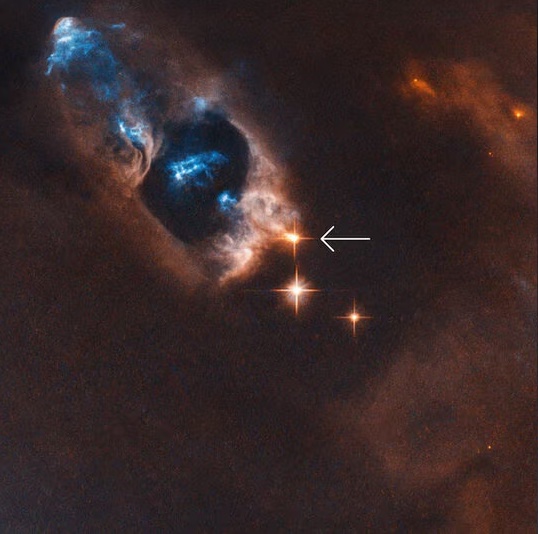 This extremely interesting system resembles to some extent TV Crt which we have been featuring for a while now. It is a binary star, both components of which have their own independent planetary systems - but there may also be a third system orbiting farther out. The two T Tau components are about 14 billion km apart and the total mass of the stars comes to just under 1 solar. They are also attended by a dynamic Herbig-Haro flow HH7-HH11 which can be seen forming a bowshock in the nebular material.
SVS 13 is immersed in the highly active starforming region of NGC1333 in Perseus, not far from TRAPPIST-1, famous for hosting seven Earth-sixed planets. Like that object, SVS-13 are dwarfs which it seems do tend to form rocky worlds. There is enough material in each star's protoplanetary disc to form a few thousand Earths - and a host of organic molecules has also been detected.
Accretion Accretion Accretion
(If Tony Blair can do it, so can I!) A recent study looked at the accretion rates among intermediate-mass T Tauri stars when compared with the slightly more massive HAeBe's, including such observational old friends as AK Sco, CO Ori, SU Aur and T Tau itself. The luminosity of the far ultraviolet (FUV) radiation will increase by orders of magnitude with increasing stellar temperature, and they propose that this increase drives a higher stellar accretion rate. This can also solve the 'lifetime problem' for Herbig disks because the increasing stellar accretion rates require lower initial disk masses to account for present-day disk masses.