YSO Bulletin
- March 2025 -
 The YSO Newsletter
First of all, welcome to the new-style online version of the YSO Newsletter. After observing that the various email clients used by section members were not only rendering the newsletter as intended (this often happens because the different clients parse the HTML coding slightly differently) but in some cases were simply not showing certain content at all!
I would be especially pleased to get your feedback on the new style (which I have tested only in Firefox so far), especially as a purely online document allows for far more sophisticated features that an email! And speaking of feedback, I have actually had some - for which see below. But I would like to kick off with some quick notes on activity among our favourite stars...
Observation Highlights
RW Aurigae is still faint, hovering currently around magnitude 13, and I am sure many of us are wondering if will be repeating its unprecedented fade in 2014-15.
T Tauri continues in its long faint state at around magnitude 12, and all observers are asked to keep at eye on it. Normally T Tau is around magnitude 10½ and could be within reach of amateur spectroscopists.
Major-length study of R Monocerotis
Section member Jean-Bruno Desrosiers responded to the call for others' contributions, and sent a copy of the Journal of the Royal Astronomical Society of Canada (RASC) for April 2025 which, apart from being a beautiful publication, contained results from a long-term study of the Herbig-type star R Mon which, as we know, is associated with Hubble's Variable Nebula NGC 2261. The project used visual and spectroscopic observations as well as imaging to not only observe R Mon itself but especially looked at the changes in the nebula and its immediate vicinity, with special reference to a jet-like structure which also varied in brightness. Jean-Bruno himself says there emerged "a bizarre fact that can only be observed using spectroscopy and multiband photometry simultaneously. The observation that the reactivity, or rather the activity of the nebula, evaluated photometrically, is inversely proportional to the continuum activity observed by spectroscopy, was in itself a remarkable phenomenon and something very interesting about a YSO, Herbig Ae/Be at that, especially since it was done by an amateur, with instruments accessible to amateurs."
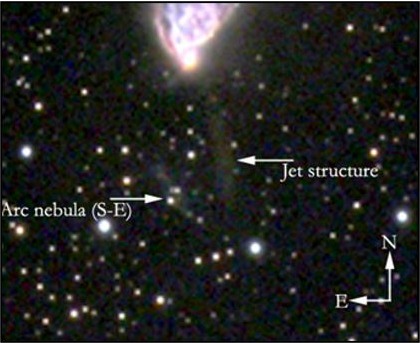 The stimulus for the study was a set of images by J.G. Moreau from 2009 and 2019, which showed the disappearance of the jet-like nebula in the southern component of the main nebula, which justified the larger, more intense follow-up in the hope of observing the evolution of this region. As can be seen here, there are two structures South of NGC 2261:- an arc-like nebulosity and the jet. While the arc-nebula did not seem to vary in intensity the jet did; and in fact the study used the arc as a 'comparison star' for the jet! The numerous graphs and figures show how the various features changed over time and included observations in several wavebands including Infra-red.
RASC members also studied the star itself of course; for example, Jean-Bruno's own observations show R Mon's B-V values fluctuating quite impressively, from 0.4 in 2020 to 1.1 in February 2024 then returning to 0.4 by November of that year, along with fluctuations over the period in other wavebands. His spectroscopic observations, as mentioned above, also revealed significant phenomena.
Especially pleasing was the contributions by a group of French school students in a citizen science project, in the form of some excellent, and revealing, images. Their project was aided by a grant from the French government.
The one downside of this article is that this issue of the RASC Journal is available only to members and institutions. In time it may be accessible online and I really urge you to have a look at it!
Lithium - it's not just for batteries!
As a fragile element, lithium is a sensitive probe of physical processes occurring in stellar interiors. A 2020 study investigated the relationship between lithium abundance and rotation rate in low-mass members of the newly
discovered 125 Myr-old Psc-Eri stellar stream. This ties in with frequent notices in the newsletter about young stars at higher-than-usual galactic latitudes. They obtained high-resolution optical spectra and measured the equivalent width of the 607.8 nm LiI line for 40 members of the stream, whose rotational periods had been derived in 2019. There was a tight correlation between lithium content and rotation rate among the late-G to early-K-type stars of the stream. Fast rotators are systematically Li rich, while slow rotators are Li depleted (since the Lithium being heavier than H or He can sink to the core regions where it is destroyed by the high temperatures. This trend mimics that previously reported for the similar age Pleiades cluster, thus the lithium-rotation connection seems to be universal over a restricted effective temperature range for low-mass stars at or close to the zero-age main sequence, and does not depend on environmental conditions (however I would point out that the Pleiades stars are high-mass objects).