YSO Bulletin
- June 2025 -
HD 97300
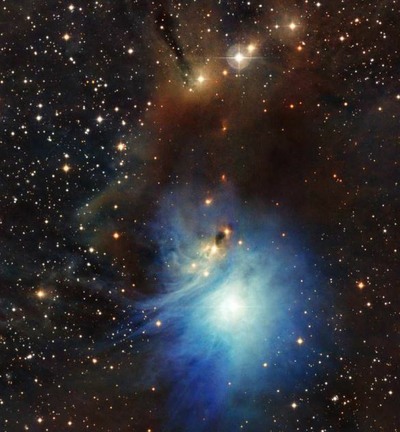 Last month we featured an HD star in Chamaeleon, and here's another one! This time we have an intermediate-mass young star in the Chamaeleon I star forming complex. It is a B9V star which is transitioning from Herbig Ae/Be type to a zero-age main sequence star. The star is illuminating the IC 2631 reflection nebula, also known as Cederblad 112. HD 97300 is an 0.8 arcsecond binary, where the lower-mass companion is about 3 magnitudes fainter at K, and thus likely a T Tauri star. HD 97300's identity as a HAeBe star indicates that it will become a higher-mass star, at least 2½ times more massive than the Sun, though it was previously thought to be a T Tauri object of solar-type mass.
Observationally the star varies with an amplitude of about 0.2m around magnnitude 9. Note also the presence of numerous dark nebulae which are precursors to large bouts of star formation.
Major Article on those HAeBe Stars!
The Star Formation Newsletter (still no news on whether it is temporarily extinct or not...) for January 2019 features a long article summarising the current state of knowledge about these slightly higher-mass objects, from which emerge several interesting facts or conjectures. One is that the A-type stars resemble their lower-mass T Tauri brothers in that magnetic fields play a major role in the accretion process, which is not the case for the hotter B stars, whose envelopes are radiative rather than convective, dampening or even eliminating the magnetic process as a producer of (for example) hot spots which are observed in cooler YSOs.
The article also mentions a 2018 study using Gaia data which found a correlation between the amount of light variability/infrared excess and mass, more variation being seen in lower-mass objects, with the difference occurring at about 7 M☉ which is twice that which was previously thought. It is believed that the higher radiation pressure from the hotter and brighter objects will result in faster clearing of the dusty discs.
And now for some low mass stars...
An Armenian study has concentrated on the IRAS 05168+3634 starforming region in Auriga consisting of 5 distinct (but presumably spatially-related) regions within a molecular cloud surrounding the five IRAS sources: 05168+3634, 05184+3635, 05177+3636, 05162+3639 and 05156+3643. Using multi-colour criteria, they identified a rich population of embedded YSO candidates with infrared excess (Class 0/I and Class II) and their characteristics. The molecular cloud includes 240 candidates of YSOs within the radii of sub-regions around the IRAS sources. The colour-magnitude diagrams of the sub-regions suggest a very young stellar population, and their ages can indeed be estimated at between 0.1-3 Myr. The SEDs are constructed for 45 Class I and 75 Class II evolutionary stage YSOs, and the parameters of those YSOs are well correlated with the results obtained by other methods.
Update on TV Crateris = HD 98800
A couple of months back I launched an AAVSO campaign on this object, a member of the TW Hya association (see previous recent newsletters for details) which may be about to enter an interesting phase of activity this Summer. Well, Summer has now officially started and so far we have seen no drastic light-changes, with the system continuing to vary, if anything, by a smaller amount, especially in B - which may of course be significant - and don't forget that negative results are also informative. Thanks to Josch Hambsch for continuing to follow this object with great persistence. I hope he receives his reward in the heavens!