YSO Bulletin
- July 2025 -
A Great Big Thank You
...from me to many of you (too many to mention in fact) following my sudden and completely unexpected heart attack last week. However, doing a small amount of research on the net and via AAVSO is more in the nature of therapy than anything else, and is not particularly energy-intensive! It's not like digging the roads up. And there is only so much daytime TV one can watch about ancient aliens, bigfoot sightings or other dubious guilty pleasures.
Pelican Babies
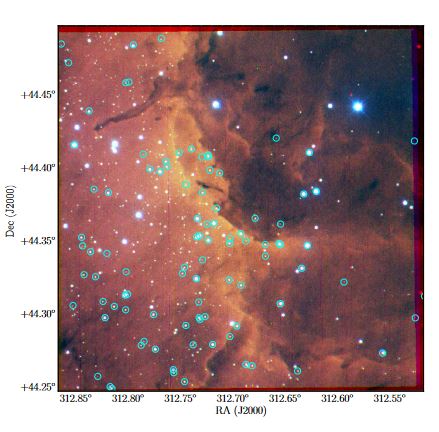 A study from 2013 concentrated on a field of 16′ × 16′ in the star-forming region Pelican Nebula (IC 5070) at BVRI wavelengths for 90 nights, spread over one year in 2012–2013. More than 250 epochs in VRI bands are used to identify and classify variables down to around mV 21. The study includes a catalogue of optical time-series photometry with periods, mean-magnitudes and classifications for 95 variable stars including 67 PMS variables in the region.
These variables are further classified as candidate CTTS and WTTS stars, based on their light curve variations and the locations on the colour-colour and colour-magnitude diagrams using optical and infrared data, together with Gaia DR2 astrometry. Classical T Tauri stars display variability amplitudes up to three times the maximum fluctuation in disk-free weak-line T Tauri stars, which show strong periodic variations. Short-term variability within single nights cannot be seen in the photometry. Several classical T Tauri stars display long-lasting (≥10 days) single or multiple fading and brightening events up to a couple of magnitudes at optical wavelengths. The typical mass and age of the PMS variables from the isochrone-fitting and spectral energy distributions are estimated to be ≤1 M☉ and about 2 Myr, respectively. There was no correlation found between the optical amplitudes or periods with the physical parameters (mass and age) of pre-main-sequence stars.
RY Tauri jets
This star, which has been on the AAVSO legacy list for several decades, has a well-known nebula attached and, because of its relative proximity and brightness, is a good object for study. However, optical and NIR observations of jet-driving sources are often hindered by the presence of a natal envelope. Jets around partly embedded sources are a
useful diagnostic to constrain the geometry of the concealed protoplanetary disc. Optical observations in polarized light show no sign of the protoplanetary disk detected by ALMA, instead, a diffuse signal resembling a remnant envelope with an outflow cavity was observed. The jet is detected in four spectral lines, appears to be wiggling and its radial width increases with distance and is complementary to the shape of the outflow cavity, suggesting a strong jet/envelope interaction.
It's that star again!
A few months back I launched an AAVSO campaign on TV Crt = HD98800, a member of the TW Hya association (see previous recent newsletters for details) which was thought could be about to enter an interesting phase of activity this Summer. Well, Summer is now well and truly here. Thanks to Josch Hambsch for continuing to follow this object with great persistence, right up until now (end of July 2025) even though observation must be very difficult. Just 3 other observers followed the object (Peter Bealo in the USA, and Ari Siqueira and Geovandro Nobre in Brasil). Observations show that the recent dampening around JD2460820 - 860 may be coming to an end, with the system beginning to revert to its previous variation cycle from around JD2460880. This may be highly significant, suggesting maybe that the periastron passage may have just occurred, with the circumbinary disc around one pair of this double-double being the source of the dampening.