YSO Bulletin
- July 2026 -
 The YSO Newsletter
First YSO Meeting!
A provisional date and time for the first online meeting of the section is 7pm UT on Saturday 22nd August, so pencil that into your diaries (virtual or otherwise)! Note that these details need to be confirmed by AAVSO HQ who will be supplying the zoom meeting room - hence the 'pencil'. When I know for definite you will all get an email confirming, or otherwise, these details.
Note: this is an actual meeting, not a webinar, and I would like our first meeting to be relatively informal but even so I have a sketchy and very basic agenda:
1) Opinions about the newsletter
2) Your Favourite YSO
3) Why they interest you
4) Genuine questions (à la webinar)
Ideally the meeting would be recorded for the AAVSO YouTube channel but as of now (29 July) I can't say for sure if this is the case. Hopefully everything will be revealed in the email.
More news on TV Crateris
Interesting developments with this fascinating object, for which see various past newsletters. I have heard from Dr Grant Kennedy at Cambridge (UK, not too far from me) and his cooperators who are also carrying out a long-term study. They say I am sure that your additional monitoring could be super useful to combine with their study which is more narrow-band and goes slightly farther into the red end. They also say in the optical spectra we may be seeing some signs of the disk (definitely we have seen the lines of Ab disappear). Since the star is quite bright around magnitude 9.3v it could be a target for AAVSOSpec so I also contacted them about following it (no reply as of yet). A second member of the research team is following up in radio wavelengths, including time on ALMA, so we could have a full-blown optical, spectral and radio coverage of the process.
My Little Runaways
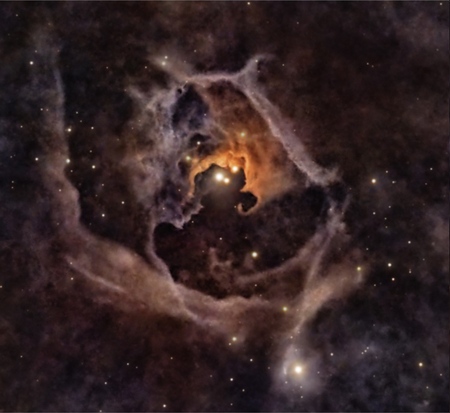 An article in last month's newsletter about high-mass runaway stars (often produced in the early stages of massive star formation) set me thinking so hard I decided to ask Prof. Bo Reipurth, he of the original Star Formation Newsletter, our big professional brother, a question: why are all runaway stars hot, massive ones? Why do we not find any runaway stars of Sunlike mass?
It turned out that he had just authored a paper on that very subject! The objects in question are HP Tau which forms, together with the late-type T Tauri star KPNO 15, a pair of oppositely directed 'walkaway' stars launched when a multiple system broke apart about 5600 years ago. In fact the system consists of 5 stars, plus another seven possible members, located inside a spooky-looking reflection nebula in the Taurus SFR, where it is part of a more scattered distribution over ~3° of more than 30 young stars that share broadly common motions. The whole article is well worth a read and so here is a link to it.