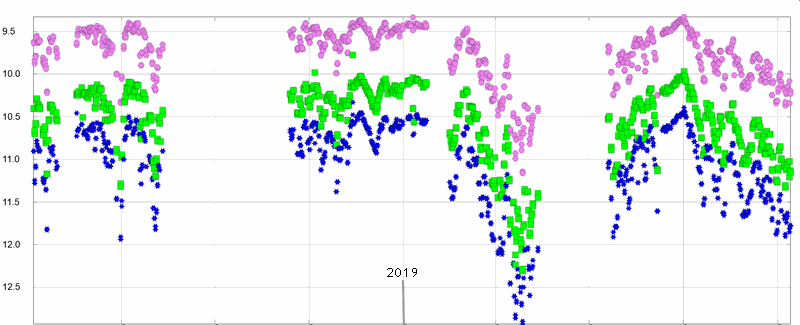
Bands are I (purple) V and B. Horizontal divisions are monthly.
| Back Issues |
 The YSO Newsletter
Our 'big brother', the professional Star Formation Newsletter has resurfaced after a year and a half of being in a coma. João Alves who runs the SFN, says: We've eliminated the traditional PDF, but, in case you need it, the web version prints cleanly to PDF through any modern browser. It won't have the polish of a typeset document, at least for now, but it requires a fraction of the work, and that matters. Sustainability matters. The SFN can only serve the community if it doesn't consume those running it.
The SFN mission remains unchanged. We're here to connect the star and planet formation community, to combat hyper-specialization, to welcome young researchers into the field, and to preserve the broad perspective that makes our field of research richer. The SFN will continue featuring News, Abstracts, New PhDs, Meetings, and Interviews that capture both scientific achievements and the human stories behind them."
They are now requesting abstracts, so we should be seeing the first of the SFN-take-2 pretty soon. Their website can be found here. Obviously it's a bit skeletal at the moment but bookmark that page for future use!
I have forwarded the AAVSO observations of this object (the vast majority by our member Josch Hambsch) to Dr. Matthew Kenworthy who has expressed strong interest in receiving them. Some idea of the amount of data can be gleaned from the fact that the text file size is half a MB! Fellow researcher Dr. Grant Kennedy may also be in the loop with this object. This simply stresses the importance of good amateur observations of such important stars.
Josch is continuing to follow TV Crt as well as some other YSOs - on which subject...
Josch messaged me saying that he would like to see more results of amateurs helping professionals (as we do!) and included a lightcurve of his observations in 4 colours over 11 years. I have taken a sample of his results from January 2018 up to January 2020 where you can see just how active and unpredictable this object is!
Bands are I (purple) V and B. Horizontal divisions are monthly.
Joey Rodriguez is assistant professor in the Department of Physics and Astronomy at Michigan State University, and is another of those professionals that are keen to receive amateur results of YSOs, since his main area of interest is in understanding "how planets form and evolve by studying circumstellar disks and exoplanets". There are several stars that he is especially interested in, including V409 Tau and DM Ori. Other stars that the AAVSO YSO group are already following are AA Tau, RZ Psc (see my paper on this one, shameless plug!) and GW Ori. It's worth pointing out that all of these 5 objects are stars that suffer eclipses by their own circumstellar discs and are also "small-to-medium telescope" bright (with the exception of faint states of AA Tau at around 16.5mv).
He has also found some 'dippers' in stellar associations such as Aur-Tau, as well as several new exoplanets. You can catch up with the wide scope of his research on his website, where you may also catch a glimpse of his cute canine companion.