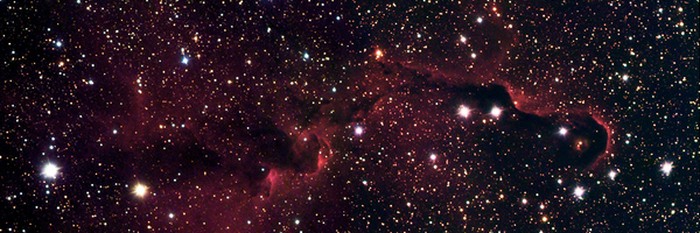
V1686 Cyg
This is a higher-mass young star associated with a small group of stars of similar age, usually identified as the BD+40° 4124 cluster.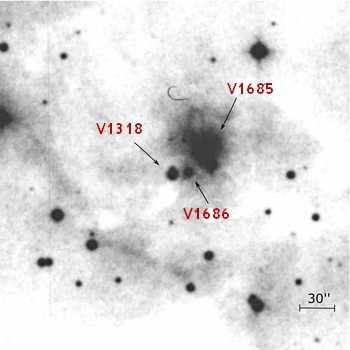 The two nebulous early-type emission-line stars BD+40° 4124 (V1685 Cyg) and LkHα 224 (V1686 Cyg itself) that define the optical appearance of the cluster have been long-recognized Herbig Ae/Be stars. It is LkHα 225 South (V1318 Cyg) that is the dominant source in mid-infrared, far-infrared, and millimeter wavelengths but a study at Byurakan (Armenia) obtained direct images and 14 medium- and low-resolution spectra of V1686. In the course of observations the star underwent an atypical brightness outburst. They found that the full rise and decline had almost 3 magnitudes amplitude and lasted about 3 months. They were also able to trace the changes of the stellar spectrum during the outburst, which are correlated with the photometric variations, many of which were supplied by AAVSO. The two nebulous early-type emission-line stars BD+40° 4124 (V1685 Cyg) and LkHα 224 (V1686 Cyg itself) that define the optical appearance of the cluster have been long-recognized Herbig Ae/Be stars. It is LkHα 225 South (V1318 Cyg) that is the dominant source in mid-infrared, far-infrared, and millimeter wavelengths but a study at Byurakan (Armenia) obtained direct images and 14 medium- and low-resolution spectra of V1686. In the course of observations the star underwent an atypical brightness outburst. They found that the full rise and decline had almost 3 magnitudes amplitude and lasted about 3 months. They were also able to trace the changes of the stellar spectrum during the outburst, which are correlated with the photometric variations, many of which were supplied by AAVSO.
Gaia 17bpi
Our big brother publication SFN, no. 316 carried an interesting article on this FUOR-type object by its admirer Carlos Peña which is the most recent star of this type to be found. It lies on the galactic equator in the constellation of Sagitta in the nebula Sh2-82 amidst a host of other young stars.
FUORs are important as many aspects of the young eruptive YSOs are still uncertain, and the frequency and amplitude of the outbursts are not well constrained. In addition, there is controversy as to whether the very largest FUOR outbursts occur across all stages of young stellar evolution or are just limited to the class 0/I phase.
Few FUORs are known because the 'download' episodes that produce the eruptions tend to happen on long, non-human timescales although the related EXORs have eruptions which are rather smaller but more frequent. |
High-mass Discs
 High angular resolution (around 40 mas) ALMA observations at 1.14 mm for a Spanish group resolved a compact (R ~200 au) flattened dust structure perpendicular to the HH 80–81 jet emanating from the GGD 27-MM1 high-mass protostar, making it a robust candidate for a true accretion disk. The jet/disk system resembles those found in association with low- and intermediate-mass protostars. Their results indicate that this accretion disk is compactwith a radius of about 170 au and massive (5M☉) and estimate the total mass of the star-disk system within a range between 21 and 30 M☉ which suggest that accretion disks around massive stars are more massive and hotter than their low-mass siblings, but they still are quite stable. High angular resolution (around 40 mas) ALMA observations at 1.14 mm for a Spanish group resolved a compact (R ~200 au) flattened dust structure perpendicular to the HH 80–81 jet emanating from the GGD 27-MM1 high-mass protostar, making it a robust candidate for a true accretion disk. The jet/disk system resembles those found in association with low- and intermediate-mass protostars. Their results indicate that this accretion disk is compactwith a radius of about 170 au and massive (5M☉) and estimate the total mass of the star-disk system within a range between 21 and 30 M☉ which suggest that accretion disks around massive stars are more massive and hotter than their low-mass siblings, but they still are quite stable.
Not-so-little runaways
The formation of the most massive stars in the Universe remains an unsolved problem. Are they able to form in relative isolation in a manner similar to the formation of solar-type stars, or do they necessarily require a clustered environment? In order to shed light on this important question, a Chile-based study looked at the origin of two very massive stars: the WN6 star RFS7 (100 M☉), and the O3.5If* star RFS8 (70 M☉), found within about 53 and 58 pc respectively from the Galactic massive young cluster NGC 3603, using Gaia data. RFS7 is found to exhibit motions resembling a runaway star from NGC 3603. This is now the most massive runaway star candidate known in the Milky Way. Although RFS8 also appears to move away from the cluster core, it has proper-motion values that appear inconsistent with being a runaway from NGC 3603 at the 3σ level (but with substantial uncertainties due to distance and age). Furthermore, no evidence for a bow-shock or a cluster was found surrounding RFS8 from available NIR photometry. In summary, whilst RFS7 is likely a runaway star from NGC 3603, RFS8 is an extremely young (2 Myr) object which might also be a runaway, but this would need to be established from future spectroscopic and astrometric observations, as well as precise distances. |