YSO Bulletin
- February 2026 -
 The YSO Newsletter
Longterm Variability study
Infrared observations can probe photometric variability across the full evolutionary range of young stellar objects, from deeply embedded protostars to pre-main-sequence stars with dusty discs. A survey published last month presented 3-8 micron light curves extending 27 years from 1997 to 2024 obtained with three space-based IR telescopes: ISO, Spitzer and WISE. Although unevenly sampled with large gaps in coverage, these light curves show variability on time scales ranging from days to decades. They focussed on the Spitzer-identified YSOs with discs and envelopes that exhibit variations of a factor of two or more in this wavelength range. They identified seven YSOs where the light curves are dominated by bursts of sustained (> 5 yr) high flux, including four that show a steep decay ending the burst and three that are ongoing as of the final observation, and they also found six YSOs that are undergoing declines, which may be the end of bursts that began before 1997. The most common form of variability, exhibited by 26 YSOs in the sample, show variations over time intervals of years to months but do not exhibit sustained bursts or fades. The Spitzer and WISE colours either increase or remain constant with increasing brightness, inconsistent with dust extinction as being the primary source of the large-amplitude variability.
Large-amplitude variability, which was defined to occur when the flux changes by a factor ≥2, may be of particular importance for the formation of stars. These variations can be driven by large changes in the mass accretion rate, where the luminosity released by accretion is reprocessed into infrared radiation. The discovery of luminous outbursts from young stars that lasted decades, and the observation that the typical luminosities of protostars are lower than the expected accretion luminosity, led to a picture where most of a star's mass is assembled during sustained bursts of rapid accretion.
The survey concentrated on well-known young associations such as NGC1333 and Chamaeleon - this last one of course the target of a recent AAVSO campaign.
Fly by night!
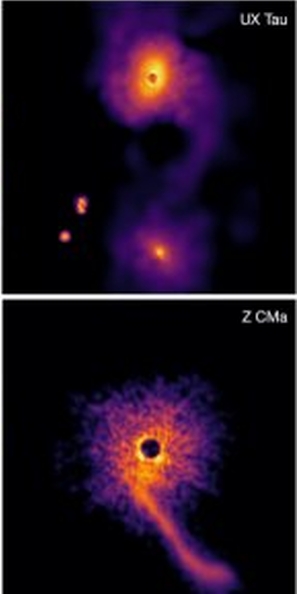 Stellar flybys are a common dynamical process in young stellar clusters and can significantly reshape protoplanetary discs. However, their impact on dust dynamics remains poorly understood. Recent 3-D simulations of parabolic stellar flybys (both coplanar and inclined) interacting with a gaseous and dusty protoplanetary disc were carried out which included dust species corresponding to four grain sizes. Perturber masses of 0.1 and 1 solar mass were considered.
The induced spiral structures exhibit distinct dynamical behaviours in gas and dust: dust spirals retain a nearly constant pattern speed, while gas spirals gradually decelerate. The pitch angles of both components decrease over time, with dust evolving more rapidly. In the weakly coupled regime, gas and dust spirals are spatially offset, facilitating dust accumulation around both structures. Equal-mass flybys truncate the disc at approximately half a Hill radius, producing tightly wound, ring-like spirals that promote dust concentration. It was seen that a low-mass flyby suppresses dust concentration below the critical clumping threshold after periastron and maintains this suppression over time, indicating long-lasting inhibition of dust clumping. An equal-mass flyby raises local solid abundance well above the threshold, suggesting that such encounters may foster conditions favourable for dust clumping. Flyby-induced spirals play a central role in shaping dust evolution, leading to distinct spatial and temporal behaviours in weakly coupled discs. Observers will probably not need reminding of the RW Aur incident a few years back when this very thing occurred, sending the star into an unprecedented decline. Above are shown flyby results from two well-observed YSOs: UX Tau and Z CMa - this last one being an especially complex and active system.
RY Tau
Another well-observed object is RY Tau with its famous variable cometary nebula. The star exhibits a dust depleted inner cavity characteristic of a transition disc. Recent observations of the spatial distribution and mineralogy of dust in the RY Tau protoplanetary disc in the inner few AU using observations in the L, M, and N bands (i.e., well into the Infrared) obtained with the VLTI/MATISSE instruments proved fruitful. Employing a 2D temperature gradient model, the study estimated the orientation of the inner disc finding no evidence of significant misalignment between the inner and outer disc of RY Tau. Several silicate species commonly found in protoplanetary discs were identified. Additionally, a depletion of amorphous dust grains toward the central protostar is observed.
Simulations show that hot dust close to the protostar and in the line of sight to the observer (either in the uppermost disc layers of a strongly flared disc, or in a dusty envelope) is necessary to model the observations.