| View Online | Back Issues |
YSO Bulletin |
 |
- Those Titillating Triple T Tauris! - | |
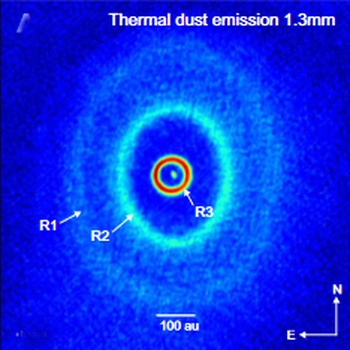
GW OrionisThis bright YSO in Ori T1 (the star formation region around λ Orionis) gets the 'my favourite object' treatment by Prof. Stefan Kraus of Exeter University here in the UK, which is quite a centre of YSO studies. He describes it as a pre-main-sequence triple with a warped disk and a torn-apart ring and is a hint - if any were needed - that star formation is a very violent process! For instance, he cites the phenomenon of disc tearing that might occur in the discs around multiple stars whose orbital angular momentum vectors are misaligned with respect to the rotation axis of the disc. All 3 stars are slightly more massive than the Sun while remaining T Tau stars. The A and B stars show a 242-day orbital period while the more eccentric, and inclined C orbits A and B in about 11 years, while both components (A/B and C) have their own circumstellar discs. Three large dust rings were detected using ALMA and some idea of the size of the system can be got from the scale in the graphic. TW HydraeMatter flowing through a star's accretion disc is channelled onto the stellar surface by the stellar magnetic field. This is thought to be strong enough to truncate the disk close to the corotation radius, at which the disk rotates at the same rate as the star. Studies of YSOs show that hydrogen emission (a well known tracer of accretion activity) mostly comes from a region a few milliarcseconds across, usually located within the dust sublimation radius. Its origin could be the stellar magnetosphere, a rotating wind or a disk. In the case of T Tauri sources, their larger magnetospheres should make them easier to resolve than with more massive stars. |
T Tau itselfA joint 2020 US-French analysis set out to reveal the nature of the enigmatic T Tauri triple star system. Multiwaveband observations show morphologies of disk material and outflow kinematics. A dark lane of obscuring material is seen in silhouette in several emission lines and dust evidence near the position of T Tau Sa+Sb, revealing the circumbinary ring around T Tau S. The flux variability of T Tau S is linked in part to the binary orbit; T Tau Sb brightens near orbital apastron as it emerges from behind circumbinary material. Outflow diagnostics confirm that T Tau N powers the blue-shifted western outflow, and the T Tau S binary drives the NW-SE flow. HQ TauThis is a 1.9M☉ classical T Tauri star (CTTS). These objects host a strong magnetic field, and both magnetospheric accretion and ejection processes develop as the young star interacts with its disk. Variability of the system was investigated by a multinational team using Kepler-K2 and complementary light curves, and from a high-resolution spectropolarimetric time series. |