YSO Bulletin
- August 2025 -
 YSO Newsletter
Breaking up is easy to do
Due to the gas-rich environments of early circumstellar discs, the gravitational collapse of cool, dense regions of the disc form fragments largely composed of gas. During formation, disc fragments may attain increased metallicities as they interact with the surrounding disc material. A two-man team from the Max Planck Institute investigated the ability of fragments to collect and retain a significant solid component through gas-particle interactions in simulations.
The formation of perturbations associated with gravitational instabilities allows particles of intermediate sizes to concentrate so that by the onset of fragmentation, the mass of local particle concentrations within the fragment are comparable to that of the gas component and the subsequent gravitational collapse results in the formation of a solid core. They found that these cores can be up to several tens of Earth masses, depending on grain size, before the fragment centre reaches temperatures which would sublimate solids. The solid fraction and total mass of the fragment depend on the metallicity of the young parent protoplanetary disc, with higher initial metallicities resulting in larger fragments and larger solid cores.
Additionally, the extended atmospheres of these soon-to-be gas giants or brown dwarfs are occasionally enriched above the initial metallicity, provided no solid core forms in the centre, and are otherwise lacking in heavier elements when a core does form.
Baby in the Fly gives birth!
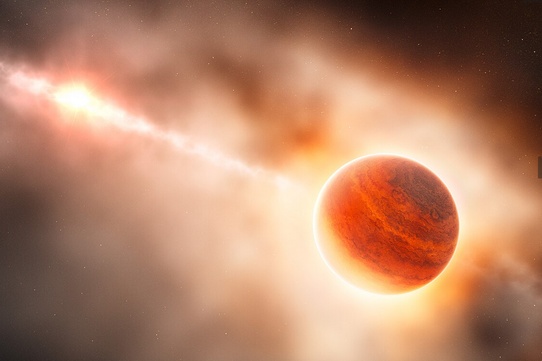 KR Muscae (also known as HD100546) is a 7th-magnitude object believed to be the closest higher-mass HAeBe YSO to us, at a distance of just over 100pc, and carries with it an extrememly interesting environment. It is surrounded by a disc with a large central region that is cleared of gas and dust (i.e., an inner hole) which usually suggests clearing-out by a forming planet. High-resolution near-infrared spectroscopy reveals a rich emission spectrum whose time-variable properties do indeed point to the presence of an orbiting companion within this hole.
The Doppler profiles of a particular CO line, observed from 2003 to 2013, reveal a source of excess CO emission that orbits the star near the inner rim of the disc, and whose properties are consistent with those of a circumplanetary disc. Earlier predictions that the orbiting source of excess emission would disappear behind the near side of the inner rim of the outer disc in 2017 were confirmed when that CO line subsequently returned to the profile observed in 2003.
The system is thought to possess at least 3 forming planets, all of which appear to be several times the mass of Jupiter, so possibly some or all of them might be brown dwarfs instead.
SU Aurigae again
 T Tauri stars are low-mass young stars whose discs provide the setting for planet formation. Despite this, their
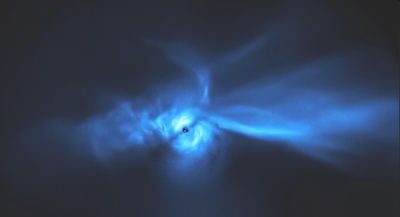
structure is poorly understood. A recent study presented new IR observations of the SU Aurigae circumstellar environment whose resolution is three times higher and with a better baseline position angle coverage than previous observations.
T Tauri stars are low-mass young stars whose discs provide the setting for planet formation. Despite this, their
structure is poorly understood. A recent study presented new IR observations of the SU Aurigae circumstellar environment whose resolution is three times higher and with a better baseline position angle coverage than previous observations.
Their aim was to investigate the characteristics of the circumstellar material around SU Aur and constrain the disc geometry. The CHARA array offered unique opportunities for long baseline observations, with baselines up to 331m. For the first time, a dusty disc wind was introduced to the simulation to model protoplanetary discs. The implementation of the study was motivated by theoretical models of dusty disc winds, where magnetic field lines drive dust above the disc plane close to the sublimation zone.
Image reconstruction revealed an inclined disc with slight asymmetry along its minor axis, likely due to inclination effects obscuring the inner disc rim through absorption of starlight (on the near side) and thermal re-emission and scattering (on the far side).
Modelling of a skewed ring finds the inner rim at 0.17 ±0.02 AU with an inclination of 50.9 ±1.0° and minor axis position angle 60.8 ±1.2°. Radiative transfer modelling shows a flared disc with an inner radius at 0.18 AU.