YSO Bulletin
- April 2026 -
 The YSO Newsletter
YSOs feed off Filaments
G183 is a 5-pc long outer Galaxy filament, and there is a massive YSO IRAS 05480+2545 named here S1 associated with it. Using the IRAM 30-m telescope at wavelenths of 1.4 and 3 mm, a recent study probed the molecular gas distribution at angular resolutions of ~12 to - 28 arcseconds corresponding to 0.1-0.3 pc at a distance of 2.1 kpc. The observations conclusively show a main filament with a skeleton of ridges. The main filament is a 5 pc long structure with a continuous and quiescent velocity field along its length up to the star-forming hub that accretes mass from the filament.
The internal gas kinematics of most of G183 is dominated by thermal motions and large-scale velocity gradients arising due to outflows and accretion of matter in the massive YSO. It is suggested that the origin of the filament is a turbulence cascade. S1 is characterized as a high-mass protostellar object with a mass of 156 M☉ and there is a kinematic signature of the accretion of material from the filament onto it. The rate of molecular gas accretion is estimated to be 8.6 x 10⁻⁴ M☉/yr). In comparison to the inner Galaxy high-mass star-forming filaments forming massive stars, G183 has a lower column density; however, the accretion and outflow rates in S1 are similar. The detection of hydrocarbons such as CH3CN and HC3N indicates the presence of hot-core chemistry in S1. These results highlight the universality of physical processes involved in massive star formation across a range of Galactic environments.
Observers may like to note that the source is in a region that includes some other high-mass YSOs (though not nearly so extreme as S1!) such as RR and CQ Tau.
More from ALMA
Infall and outflows, coupled with magnetic fields, rapidly structure the gas around newborn protostars. Shocks from interacting components encode the temperature and density distribution, offering a direct probe of the earliest evolution history. Recent observations using ALMA of the Taurus dense core MC 27/L1521F, which hosts a Class 0 protostar, detected an off-centered ring-like structure with a diameter of about 1000 AU that was not identifiable in previous data, where emission close to the systemic velocity was strongly affected by optical depth.
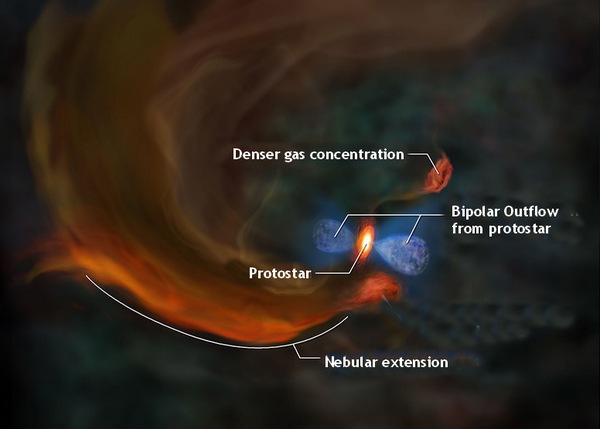
The ring shows a typical peak brightness temperature of around 3K at the chosen resolution. Other considerations indicate that the detected CO emission likely arises from relatively warm (greater than about 20K) and dense gas embedded within the surrounding cold, dense core. The morphology and kinematics suggest an energetic and localized shock-heating event, potentially linked to dynamical gas / magnetic-field interactions in the earliest protostellar phase. ALMA's results demonstrate that such observations provide a powerful new window on warm and dense gas components, enabling a more direct view of the physical processes operating at the onset of star formation.
Canis Major revisited
The Canis Major star-forming region is a remote molecular cloud complex within the recently discovered Radcliffe Wave, and remains under-explored in the literature. The stellar census here was revisited using Gaia DR3 to measure its stellar population, kinematics, and age. The survey was conducted across a 16° x 22° field encompassing the youngest subgroups in CMa. This new census identified 1531 objects as members of the CMa region, confirming 401 previously known members and introducing 1130 new candidate members. These objects have magnitudes ranging from 10 to 18 mag in the G band from Gaia DR3.
Two subgroups were identified as Cluster A and Cluster B. They are located at roughly the same distance of about 1170pc and exhibit similar space motions that can be derived thanks to the precise radial velocities obtained in the study. The subgroups have a mean isochronal age of about 2-3 Myr. However, based on infrared photometry it is seen that Cluster A has a higher fraction of disc-bearing stars, suggesting that it could be somewhat younger than Cluster B. Future studies incorporating additional data from upcoming Gaia data releases, multi-wavelength and high-resolution spectroscopic observations will be essential to further advance our understanding of the history of star formation in this region.