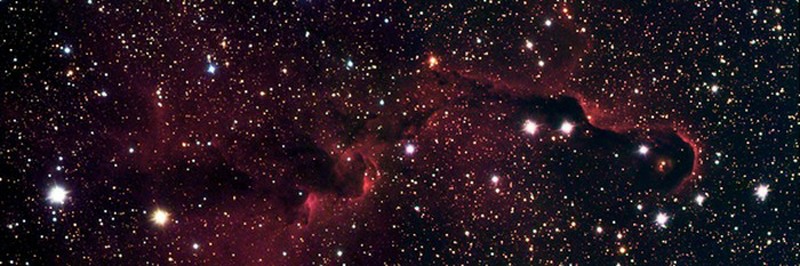
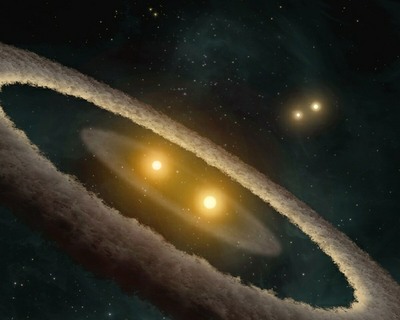
 I really want to concentrate mainly on this object because we are coming up to a significant time with regard to it. The picture here is one that you will find all over the net if you search by either of its common names (HD 98800 is the other name) but it is somewhat out of date, because we know, or at least strongly suspect, that the main circumbinary material is warped and/or inclined. Unsurprising when you consider the dynamics of a double-double system not long emerged from the chaos of the star formation process. All four stars are feeble K-type objects, and in fact the entire system is only about 2½ times the mass of the Sun. Some of the four may not have quite entered the Main Sequence so are technically YSOs, but the whole system is very young, in the order of 10 Myr, and it appears that the dusty disc is not a natal- but a recently-transitioned debris-disc.
What makes this such an exciting time is that the two pairs of stars are very shortly - within the next few months in fact - going to be at periastron, when gravitational forces will be strongest and significant because the orbits are highly eccentric and inclined. While the basic dynamics of the system are known (see below) where the AAVSO connection begins is following the light changes produced by the various circumstellar components in the periods leading up to periastron, the periastron period itself, and of course the 'retreat'. Following the light variations over this whole period may allow astronomers to reconstruct the parameters of the various system constituents including phenomena around any forming planetary bodies, as Dr. Matthew Kenworthy did so brilliantly for V1400 Centauri which you can see on the AAVSO YouTube channel.
The disc (around the B pair) produces a very high IR excess and various theories have been advanced to explain it. The only comparable system is of the PMS system GG Tau but in that case the stars are much farther apart, making for more stability in the system. The A pair is a spectroscopic binary with the secondary (Ab) having a very low mass, less than half solar. The table below gives some of the basic facts about the stars. In terms of periods, these are given for each pair (the inclination is relative to the plane of the sky) - but the period of the two pairs themselves is over 300 years - which is why we are coming up to such a critical time!